Choosing the right preschool shapes your child’s early learning experience in profound ways. Parents face a critical decision: send their little one to a Montessori program or enroll them in a traditional preschool setting. This choice affects how your child learns, plays, and develops essential skills during these formative years.
Understanding the core differences between these two educational approaches helps you make an informed decision. This guide breaks down what makes each option unique, explores their strengths and limitations, and gives you practical insights to determine which environment will help your child thrive.
What Makes Montessori Preschool Different?
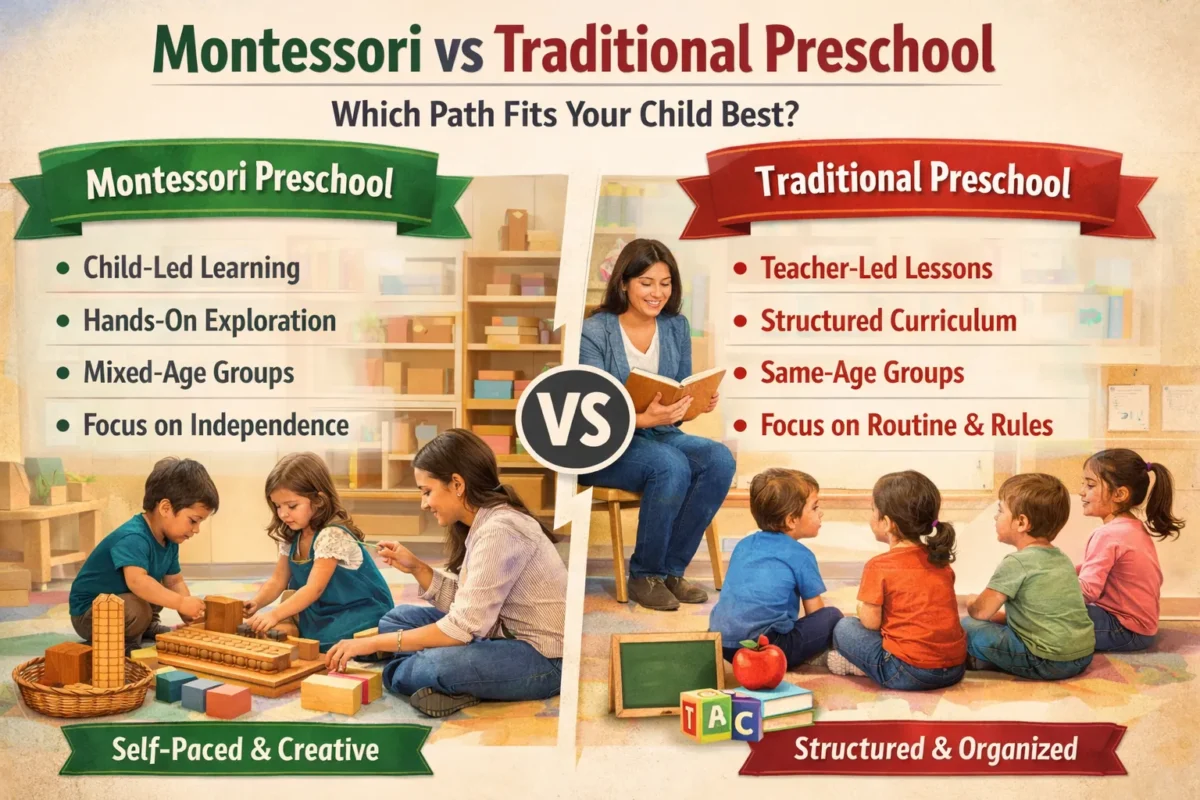
The Montessori method follows principles developed by Dr. Maria Montessori over a century ago. This approach centers on child-led learning where students choose activities based on their interests and work at their own pace.
The Montessori Classroom Structure
Walk into a montessori preschool and you will notice mixed-age groups spanning three years. A three-year-old learns alongside a five-year-old, creating natural mentorship opportunities. Older children reinforce their knowledge by helping younger ones, while younger students observe and learn from their peers.
Specially designed materials fill low shelves within easy reach. Children select work that captures their attention, whether that involves pouring water, tracing sandpaper letters, or arranging geometric shapes. Teachers observe and guide rather than direct, stepping in with gentle redirection when needed.
Key Features of Montessori Education
The montessori pre school environment emphasizes independence and practical life skills. Children learn to button their own coats, prepare simple snacks, and clean up their workspaces. These everyday tasks build confidence and fine motor skills.
Academic concepts emerge through hands-on materials. A child exploring wooden number rods grasps mathematical relationships through touch and movement, not worksheets. Sensory experiences form the foundation for abstract thinking that develops later.
How Traditional Preschool Operates
Traditional preschool follows a teacher-directed model where structured lessons guide the daily routine. Children of the same age learn together, moving through activities as a group.
Classroom Dynamics in Traditional Settings
A traditional preschool teacher stands at the front during circle time, leading songs, reading stories, and introducing concepts. Children sit together, participating in shared experiences that build community and social skills.
The day flows according to a set schedule: circle time, center time, snack, outdoor play, and rest. This predictability helps children understand routines and transitions, preparing them for kindergarten expectations.
Desks or tables arranged for group work encourage collaboration. Children complete similar tasks at the same time, whether creating art projects, practicing letter formation, or listening to stories.
Curriculum and Learning Approach
Traditional preschool curricula organize learning by subject areas and developmental milestones. Teachers present lessons designed for the whole class, adapting when individual children need extra support or challenge.
Play remains central, but teachers often guide it toward specific learning objectives. During block play, a teacher might introduce vocabulary about shapes or encourage problem-solving when towers topple.
Worksheets and teacher-directed activities appear more frequently than in Montessori settings. Children practice writing letters, counting objects, and following multi-step instructions to build school-readiness skills.
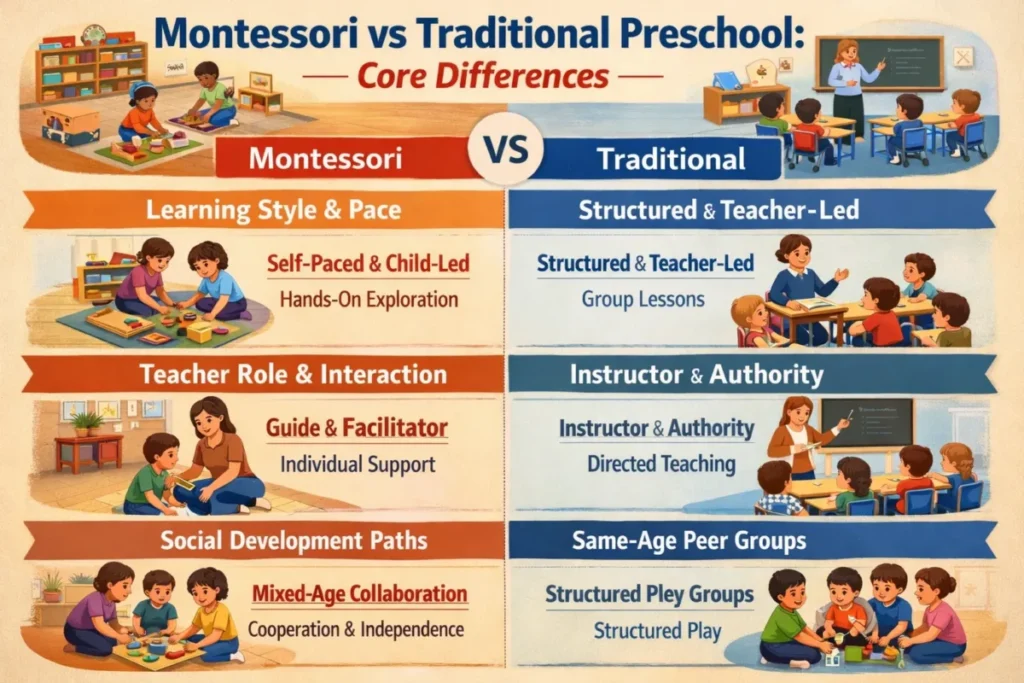
Montessori vs Traditional Preschool: Core Differences
The distinction between these approaches touches every aspect of early education. Understanding these differences helps you picture your child in each setting.
Learning Style and Pace
In the montessori school vs preschool comparison, pacing stands out. Montessori students progress through materials when they demonstrate mastery, not when the calendar says it is time to move forward. A child fascinated by sorting colors might spend weeks exploring variations, while another moves quickly to new challenges.
Traditional settings maintain group pacing. Everyone practices the letter “B” this week because the curriculum says so. This structure works well for children who thrive on routine and enjoy learning alongside peers.
Teacher Role and Interaction
Montessori teachers act as guides and observers. They prepare the environment, introduce materials individually, and watch for moments when a child needs support. Direct instruction happens one-on-one or in very small groups.
Traditional preschool teachers take a more active, directive role. They plan lessons, lead activities, and manage the classroom flow. Their energy and enthusiasm drive group participation and keep children engaged during structured times.
Social Development Paths
The preschool vs montessori debate often centers on socialization. Critics worry that Montessori students work alone too much. Supporters point out that mixed-age groups create natural social interactions without forced sharing time.
Traditional programs build in frequent group activities. Children learn to raise hands, take turns, and participate in whole-class discussions. These skills directly prepare them for elementary school expectations.
Montessori vs Daycare: Understanding the Distinction
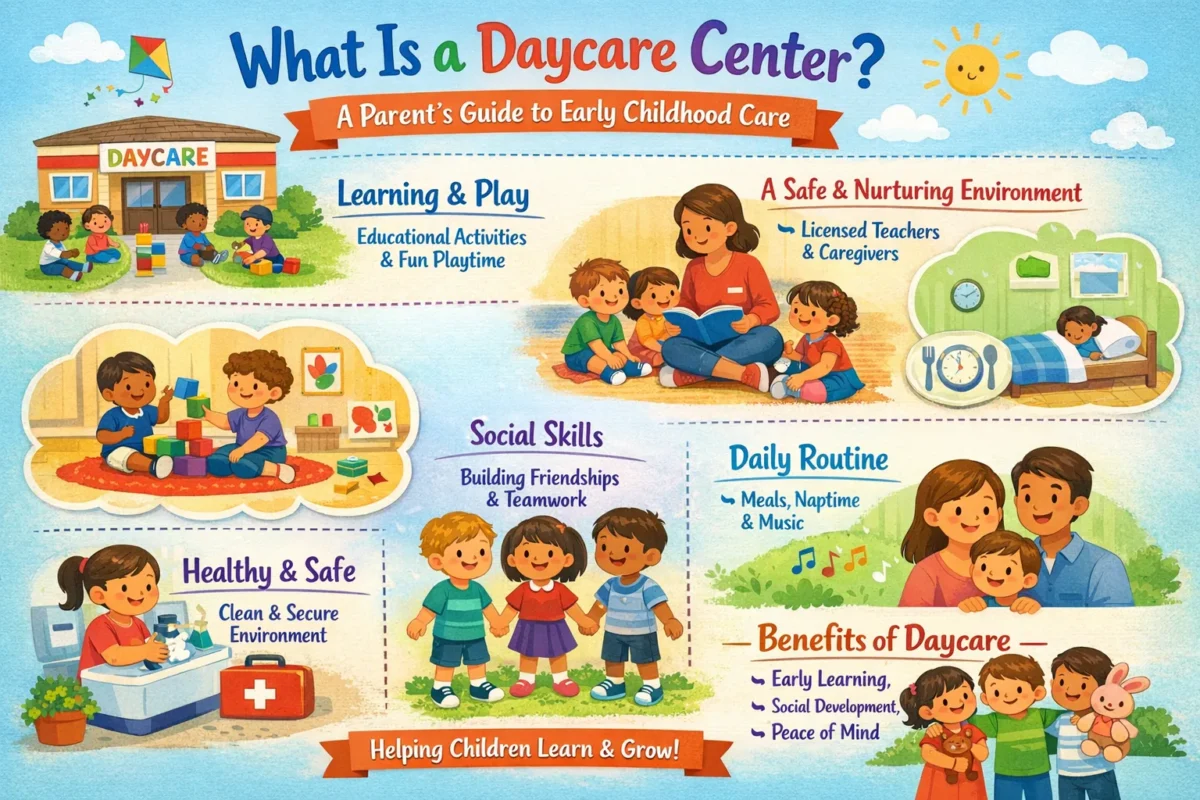
Many parents confuse preschool options with daycare services. The difference between montessori and daycare extends beyond educational philosophy to include purpose and structure.
Educational Focus vs Care Focus
Daycare primarily provides supervision and care while parents work. Staff members keep children safe, fed, and engaged, but educational goals take a back seat to meeting basic needs.
The montessori daycare vs regular daycare comparison reveals a philosophical shift. Montessori-inspired daycare centers incorporate educational materials and child-led exploration into their care routines. Children access learning opportunities throughout the day, not just during scheduled “lesson time.”
Regular daycare offers plenty of play, snacks, naps, and social interaction. Some provide structured activities, but the main purpose remains caring for children in their parents’ absence.
Age Groups and Duration
Daycare accepts infants through school-age children, often keeping kids for eight to ten hours daily. Programs adapt activities to very wide age ranges and varying schedules.
Montessori preschool typically serves children from 2.5 to 6 years old for half or full days. Some schools offer extended care, blending Montessori morning sessions with afternoon daycare services.
Montessori vs Play Based Learning
The montessori vs play based comparison confuses parents because Montessori includes play, just not in the traditional sense.
Structured vs Free Play
Play based programs prioritize child-initiated, imaginative play as the primary learning vehicle. Children dress up, build with blocks, paint freely, and engage in pretend scenarios. Teachers support this play but rarely interrupt it with formal lessons.
Montessori views “work” and play as one experience. A child pouring water practices concentration and coordination. They play with purpose using materials designed to isolate specific skills.
Play based vs montessori programs both respect childhood and child development. They simply define play differently and structure the environment to match their philosophy.
Balance of Freedom and Structure
Both approaches offer freedom within limits. Play based settings let children choose activities from available options and explore materials creatively. Teachers observe play and sometimes join to extend learning.
Montessori provides freedom to choose from prepared materials and work independently. The structure lies in how materials are used. A child cannot bang puzzle pieces or dump water randomly. Each material has a purpose and proper use.
Cost Considerations: Is Montessori Preschool Worth It?
Finances play a real role in this decision. Montessori programs often cost more than traditional options, though prices vary widely by location and specific school.
Why Montessori Costs More
Specialized training for Montessori teachers requires significant investment. Authentic Montessori materials are expensive, hand-crafted items that schools must purchase for each classroom.
Lower student-to-teacher ratios in many Montessori schools increase staffing costs. The individualized approach demands more adult attention per child.
Evaluating Long-Term Value
Whether montessori preschool is worth it depends on your child, your values, and your specific school options. Some children flourish with independence and hands-on learning. Others need more structure and direct instruction to stay engaged.
Visit both types of schools in your area. Observe actual classrooms, not just promotional materials. Talk to parents whose children attend. Quality matters more than philosophy when it comes to your child’s daily experience.
Making Your Decision: Which Approach Suits Your Child?
No single answer works for every family. Your child’s personality, learning style, and needs should guide this choice.
Signs Your Child Might Thrive in Montessori
Consider Montessori if your child shows strong independent tendencies, becomes deeply absorbed in activities that interest them, and resists being rushed through transitions. Children who learn best through movement and hands-on exploration often love the Montessori approach.
Kids who need quiet time to focus benefit from environments where they can work alone without constant social demands. If your child already shows interest in practical tasks like cooking or organizing, Montessori builds on these natural inclinations.
Signs Traditional Preschool Might Be Better
Traditional settings work well for highly social children who thrive on group energy and peer interaction. If your child loves performing, participating in group activities, and learning through teacher demonstrations, a traditional classroom might feel like home.
Children who struggle with decision-making in open environments sometimes feel overwhelmed by too many choices. The structure and clear expectations of traditional programs provide helpful boundaries for kids who need them.
Questions to Ask When Visiting Schools
Beyond montessori vs traditional daycare considerations, evaluate specific schools on their own merits. Ask about teacher qualifications, staff turnover, and safety protocols. Watch how teachers interact with children during difficult moments.
Observe whether children seem engaged and happy. Notice if the space feels calm or chaotic, clean or cluttered. Trust your instincts about whether this environment will nurture your unique child.
Request information about curriculum, daily schedules, and communication practices. Schools should eagerly share their approach and welcome your questions.
The Montessori Kindergarten Question
Some families choose Montessori for preschool but wonder about continuing for kindergarten. The montessori kindergarten year offers rich benefits as children complete the three-year primary cycle.
Five-year-olds become classroom leaders, cementing their knowledge by helping younger students. They tackle advanced materials and develop strong academic foundations in reading, writing, and mathematics.
However, transitions to traditional elementary school generally go smoothly. Children adapt to new expectations when teachers help them understand different classroom norms.
Montessori School Pros and Cons
Every approach has strengths and limitations worth considering.
Advantages of Montessori
Children develop strong self-direction and independence. They learn to manage time, make choices, and persist through challenges without constant adult intervention.
Hands-on learning builds deep conceptual understanding. Abstract concepts become concrete through materials children can touch and manipulate.
Mixed-age groups create natural leadership opportunities and eliminate competitive pressure. Children progress at their own pace without comparison to same-age peers.
Potential Drawbacks
The freedom can overwhelm children who need more structure or who avoid challenging tasks when given choice. Some kids drift without teacher direction.
Fewer opportunities for group activities and performances may not suit highly social or expressive children. The quiet, focused atmosphere feels restrictive to some personalities.
Transitions to traditional schools sometimes require adjustment, though most children adapt successfully.
Traditional Preschool Strengths and Weaknesses
Traditional programs offer their own set of benefits and challenges.
Benefits of Traditional Approaches
Structured routines and clear expectations help children develop school-readiness skills. They learn to follow directions, participate in groups, and manage classroom transitions.
Teacher-led instruction ensures all children receive introduction to essential concepts. No child slips through without exposure to letters, numbers, and basic academic skills.
Group activities build social skills and classroom community. Children learn to cooperate, share attention, and appreciate peer contributions.
Possible Limitations
One-size-fits-all pacing may bore advanced learners or rush struggling students. Individual needs can get lost in group instruction.
Less hands-on exploration means children spend more time sitting and listening than moving and doing. Active learners may struggle with extended circle times.
Teacher-directed environments provide fewer chances to develop self-direction and decision-making skills.
What Does Research Say?
Studies comparing montessori school pros and cons with traditional outcomes show mixed results. Some research indicates Montessori students demonstrate stronger executive function skills and creativity. Other studies find no significant differences in long-term academic achievement.
The quality of the specific program matters more than the philosophy. A well-implemented traditional preschool outperforms a poorly executed Montessori program, and vice versa.
Are montessori schools good? When they follow authentic Montessori principles with trained teachers and proper materials, they offer excellent early education. However, schools using the Montessori name without true implementation fall short of the method’s potential.
The Bottom Line for Your Family
The montessori meaning emphasizes respect for the child as a capable learner. Traditional approaches emphasize preparing children for school expectations and building classroom community. Both philosophies have merit and produce successful students.
Visit schools of both types. Observe your child’s response to different environments. Consider your family values about education, independence, and childhood.
Some families split the difference, choosing Montessori for preschool and traditional kindergarten, or vice versa. Others find hybrid programs incorporating elements of multiple approaches.
Your child will learn and grow in either setting when teachers are caring, the environment is safe, and the program maintains quality standards. Trust yourself to recognize the right fit when you see it.
The best preschool for your child is the one where they feel happy, secure, and excited to learn each day.
Frequently Asked Questions
What is the main difference between Montessori and preschool?
Montessori emphasizes child-led learning with hands-on materials and mixed-age groups, while traditional preschool uses teacher-directed lessons with same-age peers. Children choose their own work in Montessori versus following group activities in traditional settings.
Is Montessori better than traditional preschool?
Neither is universally better. Montessori suits independent, hands-on learners who thrive with choice. Traditional preschool works well for children who enjoy structure and group learning. The best choice depends on your child’s personality and needs.
How does Montessori differ from regular daycare?
Montessori focuses on education through specially designed materials and trained teachers following a specific philosophy. Regular daycare prioritizes care and supervision with varied activities. Montessori programs typically serve specific age ranges with intentional learning environments.
Does Montessori prepare children for kindergarten?
Yes, Montessori students transition successfully to traditional schools. They often show strong independence, focus, and academic skills. Teachers help children adjust to new classroom expectations when transitioning from Montessori to traditional settings.